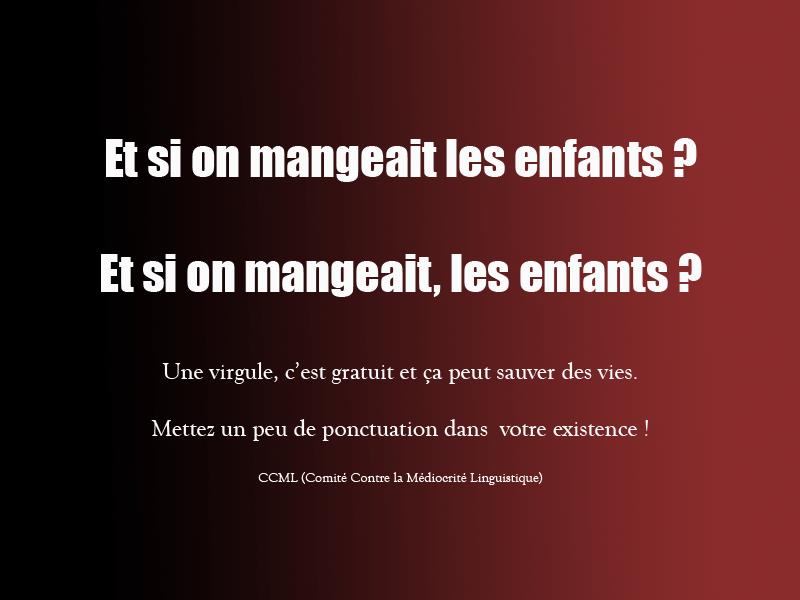
Warning: Comma Omission May Lead to Cannibalism

Translation:

“Shall we eat kids?”

“Shall we eat, kids?”

That the omission of such a tiny smudge of ink could result in such tragic consequences. Perhaps the old lady in Hansel & Gretel simply misread the memo?

Remember folks, proper punctuation prevents pandemonium.


Sand & Pancakes

Me: ‘Would you like some honey on your pancakes?’

I knew there was only a tiny bit of maple syrup left and I was hoping to save it for myself. If I am going to consume the calories, I want to really enjoy them, which can only be done with good maple syrup.

P: ‘Non, je veux du sirop de sable.’ [No, I want sand syrup]

I know at this point I am supposed to correct her by using the right word myself as in:

‘D’accord, voici le sirop d’ÉRABLE’ [Sure, here is the maple syrup]

…while poring maple syrup on her pancakes.

But like my father who refused to correct my mother’s ‘frenchisms’, some things are just too cute to correct. I know that just as she learned that she wanted to sit on my lap and not my lacks, she will self-correct. I hope she will forgive me for dragging out the process for my own gratification.

At a Loss for Words: My Foreign Language Meltdown

I am probably spoiled, being brought up bilingual and exposed to many languages and cultures. Perhaps I just haven’t been adventurous enough in my travels, but I don’t ever recall finding myself in a situation where I could neither derive any inkling of meaning from the exchange nor express in any terms or gesticulations what I needed to say—that is until now.

A few days after arriving at our new home in Bangkok, I set off for the hospital with a hefty fever, bronchitis and my two kids in tow since one of them was also sick. We had an easy and quick taxi ride there, despite the dreaded traffic, and shelled out just over 50 Baht (US $1.65).

An hour or so later, wowed by the incredible efficiency of our visit and the modernity of the hospital, and carrying two stylish bags of meds for my eldest and myself, we took a taxi back home. I check if the driver knows the main artery we live right beside, since I am utterly incapable of giving detailed directions. Geez I can’t even introduce myself yet.  The driver vigorously shakes her head, yes, she knows, and off we go. I am not too worried as I have the address written both in roman and Thai characters as a backup.

Fast forward twenty minutes with no recognizable landmarks, and she makes the first call for directions…

This post was written for In Culture Parent. To continue reading please click here!

QuickPost #2: ‘A Fish In Your Ear’: What Gets Lost In Translation via NPR

‘A Fish In Your Ear’: What Gets Lost In Translation

by NPR Staff

NPR – November 15, 2011

The Russian language has a word for light blue and a word for dark or navy blue, but no word for a run-of-the-mill generic shade of blue. So when translators are tasked with converting “blue” from English to Russian, they’re forced to choose a specific shade.

It’s hard to imagine that this particular choice would have any serious implications, but interpreters are constantly translating concepts into other languages with words that have no exact match.

In his book, Is That a Fish in Your Ear?, David Bellos explores the history, the future and the complexity of translation — from the tangled web of simultaneous translation at the United Nations, to movie subtitles and the text on ATM screens.

NPR’s John Donvan talks with Bellos, director of the program for translation and intercultural communication at Princeton University, about the art of translation, and what’s lost — and gained — in the process.

Interview Highlights

On why translation is integral to relating to others

“We translate all the time. If we refuse to translate, refuse to listen to what other people have to say to us, whichever language it is in, we’re not living as fully as human beings as we could be …

For the rest of this wonderful article, click here