Old Dog, New Tricks? My Journey Learning a Tonal Language Just Shy of 40.

It’s official. Our family unit is relocating to Bangkok. The idea may have been floated around for quite some time, but the journey from ephemeral scenario, to signed contract and booked shippers took no more than a fortnight.

There is much that can and will be written about this new adventure but right now I am trying to get my head around the idea of learning Thai. Having spent about 17 months in Asia for Starters -read Singapore- where everyone speaks English or some form of it, it is easy to forget that once upon a time, living in another country meant learning a language or having your country colonize it so you could speak yours. (The latter a clear favorite with us Europeans). Thanks to that fact, when traveling around South East Asia, it is generally easy enough to get by with English or French. So why is Thailand different?

Don’t let this land of a thousand smiles fool you, the Thai people are FIERCE. Thailand is the only South East Asian country that was not colonized; that should tell you something. Don’t imagine that everyone you meet will speak some English. They won’t. And for the time being, even those who do are utterly incomprehensible to me and most people I know who have traveled there. And I have a very good ear for languages and deciphering what people are trying to say.

Even if it may be possible to survive by always printing the address in Thai for a cab driver or pointing to what I want to eat to get by, that’s really not the experience I want. I may be moving into an expat enclave for starters, but I don’t want my life there to be entirely sheltered from the real life taking place in the streets around me.

My father, who once owned a travel agency, told an American couple who wanted him to book them a trip through Europe staying only at American hotels that served American food that they might as well save their money and stay at home or find another agent. I couldn’t agree more. Our choice to live in Asia was never about pretending I am at home with better weather and cheaper help.

What I know about the Thai language so far:

  • It is tonal with low tones, high tones, mid-range, rising and falling.
  • There are no conjugations. (HOURAH)
  • There is no standard romanization. Actually this isn’t entirely true. A standard guide was created primarily for Academia but no one uses it at all. What does this mean? You really need to learn how to read Thai.
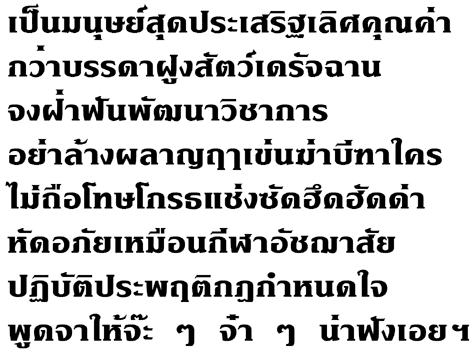
  • They do not put spaces in between words. This is something I am really going to have to get my head around.
So here goes my little experiment to see whether you can in fact teach an old dog new tricks!

ps. I am back from my online hiatus!

QuickPost #2: ‘A Fish In Your Ear’: What Gets Lost In Translation via NPR

‘A Fish In Your Ear’: What Gets Lost In Translation

by NPR Staff

NPR – November 15, 2011

The Russian language has a word for light blue and a word for dark or navy blue, but no word for a run-of-the-mill generic shade of blue. So when translators are tasked with converting “blue” from English to Russian, they’re forced to choose a specific shade.

It’s hard to imagine that this particular choice would have any serious implications, but interpreters are constantly translating concepts into other languages with words that have no exact match.

In his book, Is That a Fish in Your Ear?, David Bellos explores the history, the future and the complexity of translation — from the tangled web of simultaneous translation at the United Nations, to movie subtitles and the text on ATM screens.

NPR’s John Donvan talks with Bellos, director of the program for translation and intercultural communication at Princeton University, about the art of translation, and what’s lost — and gained — in the process.

Interview Highlights

On why translation is integral to relating to others

“We translate all the time. If we refuse to translate, refuse to listen to what other people have to say to us, whichever language it is in, we’re not living as fully as human beings as we could be …

For the rest of this wonderful article, click here

Terms of Endearment: How Wire Hangers and Greek Nomenclature Define our Family.

As a little girl I called my parents Maman and  Pop. I never really stopped to think about their names. My American Grandfather and step Grandmother were called Grandpa and Mary (or The Dragon Lady behind her back). It’s a miracle that one never slipped out. As a little girl, I thought it had to do with her beautiful, colorful kaftans, not my father’s sentiments for her. Funny how kids interpret things.

In France, they were Grand-Pere and Grand-Mere. At a certain age, I wondered why most of my cousins called my grandmother Mamie. I asked my mother about it and she told me she didn’t want to confuse me as Mamie, a common term for grandmother, was too close in pronunciation to Mommy. I had an “A-HA” moment as I never really put the two together until then.

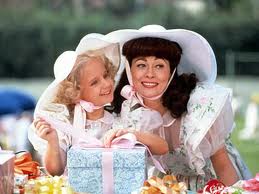
I do recall a time when I wanted to call my mother Mommy and even tried to. As I remember it, she would respond that she wasn’t Mommy but Maman. I don’t think her request bothered me at the time. That said, as I got older and would occasionally call her Mommy by accident. I remember she would get annoyed because it reminded her of the film “Mommy Dearest”. Boy admitting that was one of her finest mistakes. As a tween & teen I could imply she was being horrible without actually saying the words. I’d run around the house shouting “NO MORE WIRE HANGERS!!” – a mechanism to push her buttons as easy as the actual push of a button!

Fast Forward enough years to make me a mother. (I may not be Joan Crawford but I can still be in denial about my age.)

THE PARENTS
For Javier, it should be fairly straight forward as the word for father is the same in French and Spanish: Papa. Still Daddy keeps cropping up. I’m blaming the school and no it definitely doesn’t have anything to do with any TV  I may be allowing her to watch!  And me? For the longest time, my eldest called me Mama because my husband refers to me as such. Somehow I did get her to call me Maman for a while and then she switched to Mommy. I try to encourage her to call me Maman. I don’t know what it is but I don’t feel like a Mommy. I am sure somewhere there is some book that says you will deeply scar your child if you refuse to respond to their attempts to call you by whichever name, but think of me as supporting the economy by investing in the future of psychotherapists and the like.

As an aside I’d love to be called Mummy. Chalking that one up to the 10 years I spent in the UK. I wonder if French mothers in the UK resent it because they envision Tutankhamun or Scooby-Doo.

THE GRANDPARENTS
At this point you may be wondering where the Greek nomenclature comes in. My mother decided that her grandchildren would call her Yaya and my father Papou. It’s not that I dislike these names. In fact I feel an attachment to Yaya as this term is used in Turkey where I lived for a time.  Papou is sweet and it has grown on me as I hear my eldest daughter use it. But we aren’t Greek, have any Greek heritage, nor ever lived in Greece. And truth be told, it is uncomfortably close to Poo-poo. There I said it. Maybe it’s a good thing we don’t live so close to my parents. I can hear it now “Papou I need to Poopoo!” but she never just says things once. Try saying that 5 times in a row quickly. You get the picture…

I should say this whole post was inspired by a post I read on the topic. There I discovered another word for mother: Emme. I think Emme is so beautiful. Separately, I’ve always loved the Danish words for Grandmother and Grandfather, especially how they differentiate the set of grandparents (maternal or paternal). Mor is mother. Far is father. So MorMor means my mother’s mother and MorFar is mother’s father.  I wish I could have persuaded my parents to adopt that but no such luck.

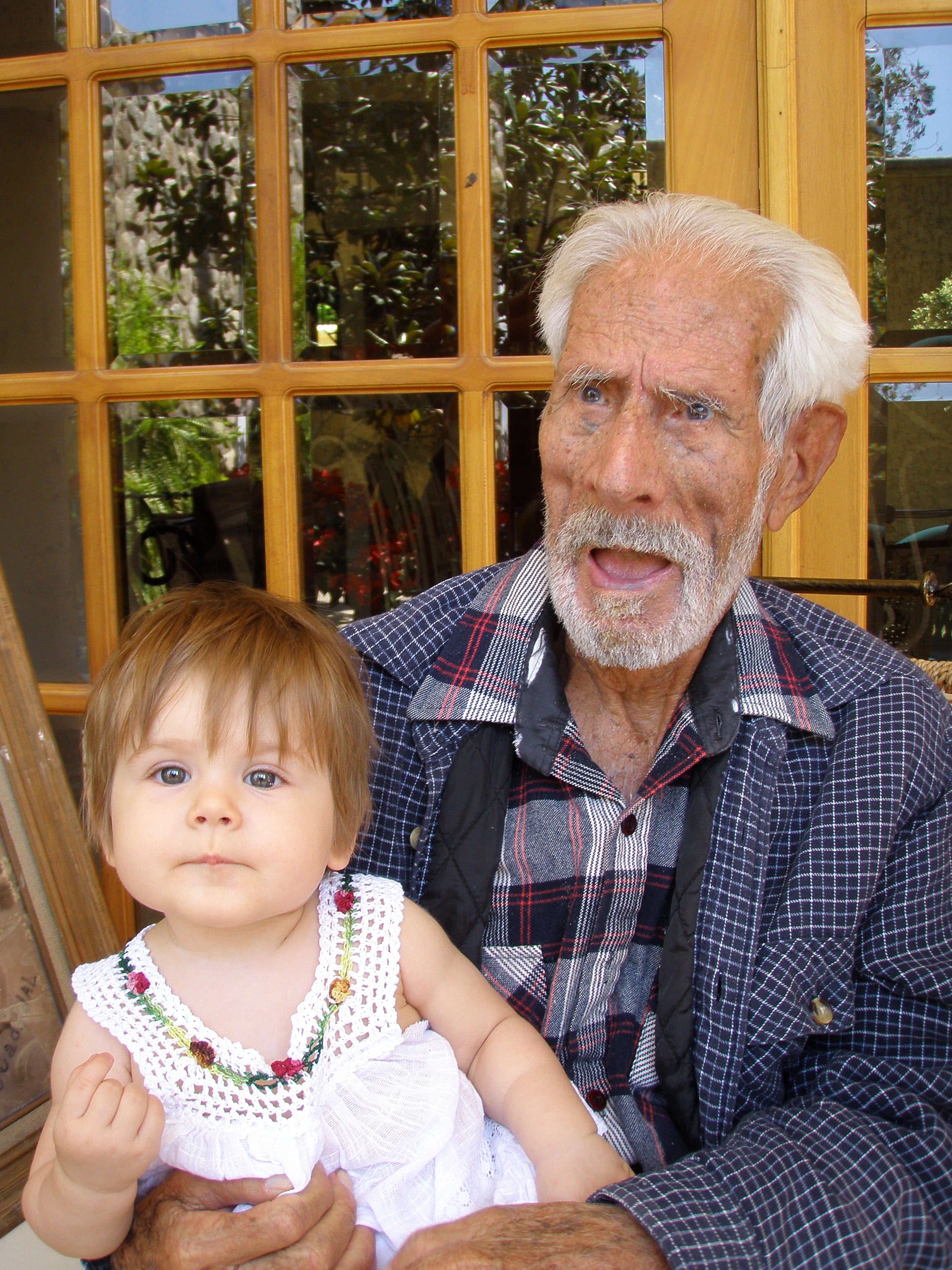
Pea With Tatarabuelo (Great Grandfather) in Autlan 2009.

What do you call parents?Grandparents? Do you wish you could rename anyone? I wonder how many wonderful options are out there that I don’t know about. And if you have any latin grandparents, what do you call them? We refer to Javier’s parents as Abuelito y Abuelita but P hasn’t seen them since she could talk so who knows what will emerge. Maybe, just maybe, since my Franco-American parents have Greek names, my Mexican in-laws may be persuaded to take Scandinavian ones. No harm in asking!

Afterthought: While checking the spelling of Papou, I came across a thread stating that Opa means grandfather in German but Older brother in Korean. Of course the person who posed the question actually wanted to know what it meant in Greek.

Quick Post: We Will Take a Plane to Monday!

My eldest daughter P loves to fly. (Would’ve fooled me). Still, she is always asking to take a plane. Seriously again and again and again. It gets annoying, mostly because I want to respond:

Yes well if we had more money we would take planes a lot! But we don’t so please stop reminding me.

But I am currently able to refrain from drinking during the day so instead I calmly answer:

Bientot Cherie, bientot on prendra l’avion. Je te le promets.

This means “Soon Darling, soon we will take a plane. I promise”. This borders dangerously on promises I might not be able to keep but I guess I like living on the edge.

I tried changing the conversation by asking her to where we should fly. I expected to hear something along the lines to Yaya’s or to Michel’s château. Instead she responds:

We will take a plane to Monday!

Uhm… Ok. I was stumped there for a second. I quickly realized that I wasn’t able to explain why that wasn’t possible in French or English. So you know what they say: “If you can’t beat them, join them!”

Sweetie, Papa would rather take a plane to Friday.