Sand & Pancakes

Me: ‘Would you like some honey on your pancakes?’

I knew there was only a tiny bit of maple syrup left and I was hoping to save it for myself. If I am going to consume the calories, I want to really enjoy them, which can only be done with good maple syrup.

P: ‘Non, je veux du sirop de sable.’ [No, I want sand syrup]

I know at this point I am supposed to correct her by using the right word myself as in:

‘D’accord, voici le sirop d’ÉRABLE’ [Sure, here is the maple syrup]

…while poring maple syrup on her pancakes.

But like my father who refused to correct my mother’s ‘frenchisms’, some things are just too cute to correct. I know that just as she learned that she wanted to sit on my lap and not my lacks, she will self-correct. I hope she will forgive me for dragging out the process for my own gratification.

Milk, Wheat and Word Construction.

I was at a loss for words as I pondered what to write for the Bilingual Carnival hosted this month by Gato and Canard. I decided to join the corporate ranks and experiment in the art of outsourcing read I contacted our host to ask her if there was anything in particular she would be interested in. She responded that she would like a post on WORDS. Yes I found this funny given I had none in my mind but then something happened. I remembered a post I’ve wanted to write for the last eight months but have never been able to get around to, until now.

When we visited some of my family in France last summer, I had huge hopes and perhaps even expectations —always a dangerous thing— of how my oldest daughter’s spoken French would emerge. Despite only spending just under 3 weeks and having her Spanish-speaking father and English-speaking Grandfather around, I felt confident that given her understanding of French, the words would suddenly come spilling out.

I can assure you this did not happen. Fortunately the disappointment was lessened by my enjoyment of a particularly cold summer —we live in the tropics so this is good news to me— coupled with other family dramas that moved language acquisition right to the bottom of my list of worries. But before my attention was absorbed with more pressing matters, I did manage to jot down one of my favorite linguistic anecdotes to date.

Towards the end of our drive from Paris Charles de Gaulle to southern Normandy where we were initially staying, we passed a number of wheat fields. Having lived in New York City, Singapore and traveled to Mexico where the only fields my eldest had seen were brown, of shopping malls and a blue-green one of agave. I was excited to point out the fields of wheat and explain what they were. My relationship with nature and particularly my understanding of where food comes from had nearly always originated during my summer holidays in France as a child; I looked forward to sharing this with P.

Me: “Regarde le champ de Blé!” [Look at the wheat field!]

P: “du lait?” [milk?]

Me: “Non, du BLÉ” [No, wheat]

P: “oui LAIT!” [ yes milk]

Me “Non, B-B-B + lé. BLÉ” [No + attempt to sound out wheat in French]

P: “Oui, B-B-B + lait”

Me, now ecstatic: “OUI! BLÉ!”

P: “OUI! B-B-B- MILK!”

Ok, I can see how that would make sense to her.

Word construction is a funny thing. Most of us don’t think about it much except perhaps during SATs, in the US anyway and maybe when our children start speaking. But there is a whole other level of fun that happens with many multilingual kids as they work to tease out sounds, words and separate languages.

I hope you will share your favorite creative word or sentence construction!

French Evolution, Dormant Skills and Why We All Just Need to Chill.

No I am not referring to a sudden Gallic change of heart towards pasteurized milk and turning le steak tartar into le burger. That wouldn’t be evolved, just paranoid.

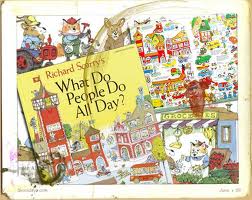
I am talking about the amazing ability of dormant skills to switch on like genes under the right conditions. It’s how even if your child refuses to speak to you in the tongue you have tirelessly dedicated yourself to, spending countless amounts of discretionary income, which isn’t really discretionary since it should be paying off credit card bills, school loans and the IRS, on books, toys and language reinforcing trips. It’s the hours you spent after your toddler is asleep neglecting laundry, work, and soap scum around your tub while looking up words from your child’s favorite book —one of the few not in your chosen language— because you just don’t know how to say digger, spade, otter and jungle gym in your supposed mother tongue so translating on the fly is not an option. (Richard Scarry why aren’t more of your books available in other languages? Hmm probably because no one else knows those words either…)

I digress.

The flick of the switch can happen at any point. For some it’s right away, like babies who just learn how to sleep by themselves. It isn’t that the parents have done anything better than you, they just lucked out in the baby lottery. It happens during a summer visit to Granny’s when you are sneaking away for a nap and the child really wants a chocolate biscuit. It happens when your new neighbors speak the same other language than you and since you have no money for a babysitter or extra help or any family in a 80 mile radius, that all your social life revolves around ‘couples’ evenings with the kids and portable cribs. It happens when at 15, when she realizes her multilingualism will help get that cute boy’s attention. Or in my case it happens when I agree to move to the other side of the world so I can afford to send my kid to the French Private school.

And it is finally paying off. It has been really interesting to watch the emergence of P’s French on high-speed. The last 5 weeks have sort of played out as follows:

End of Week 1: P comes home and seems happy at school. I attribute that to her understanding French even if she didn’t speak it and the fact that almost everyone around her understands English. Teacher emails me asking me to please try to encourage her to speak French, a suggestion I mostly ignore though I am careful not to slip into English at any point during this transition.

End of Week 2: Not much difference though P seems to repeat the odd French word I say burying it deep within an English sentence.

End of Week 3: Frequency of repeated French words increase including ones she is picking up at school. Still the English sentence rules. A few short French Phrases start emerging, things like “Non! C’est a moi!”. Hello survival of the fittest.

End of Week 4: Her sentences are increasingly half French, half English. I begin to feel the balance of power shifting.

End of Week 5: I nearly fall of my chair when in mid battle with her sister, Pacifique turns to me in desperation and yells “Maman met ça dans ma chambre s’il te plait” while handing me some prized possession. [Maman, please put this in my room]. I feel like once the motor is running, she is more likely to initiate conversations with French

End of Week 6:  An English-speaking friend comes to visit. I speak more English at home. I inadvertently speak more English to her and immediately I hear more English out of her mouth. It is a delicate dance, but I am starting to understand the steps.

So relax, It will happen. Maybe right away, maybe not for another decade, but it WILL happen.

How My Tones Are Interfering with Thai Tones.

Ask anyone about learning Mandarin – because apart from some business men, some lonely men and the odd highly motivated expat, who actually learns Thai- and they will say something along the lines of  “Too hard; it’s a tonal language!” and “You have to start them young”.  This latter idea is definitely embraced in certain US circles (erhum Park Slope) where hearing about families who’ve enrolled toddlers in Mandarin classes or imported a Mandarin-speaking nanny is de rigueur.  For the rest of us who aren’t up to mapping out our 3 year old’s trajectory towards being the next ruler of the universe, learning a tonal language was  written off long ago along with professional ice skater and rock solid abs.

As a language lover inflicting a number of languages on my kids and with plans to stay indefinitely in Thailand, I felt it was only fair to embark on this journey and prove people wrong. It was about three days into my intensive Thai lasses when I realized that English is also a tonal language. If you disagree me, consider the ‘upspeak‘ trend. That may be an extreme example but you get my point. Even before the advent of the nextgen valley girl, we’ve always had tones. We may not use them to ascribe a specific definition to a word but we do use them to convey feeling, tone and even meaning.

Just imagine someone whose just touched the top of a car sitting in the Arizona desert for a few hours:

“That’s hot.”

vs. Paris Hilton complimenting her current sidekick in a new sexy dress:

“That’s hot.”

Toddlers possibly use our most common heard tone about a 100 times a day. You don’t believe me? Ask any parents who’ve been driven crazy by the constant barrage of “Why” Questions.

“Why do we flush?”

“Why do I have to go to bed?”

“Why is your stomach so mushy?”

In many cases, we use a rising tone to indicate we are asking a question. And this is where I am hitting a wall. You see Thai has 5 Tones: Normal, Low, High, Falling & Rising. It turns out I simply cannot end a statement with a word that has a rising tone mark. Rising Tone = Question. This is categorically ingrained into my brain. It would be like telling me a red light meant walk and a green light stop. No can do.

But this is the least of my problems. I’ve just figured out something else much more disturbing. I had been happily plodding along thinking that if I managed to acquire a decent amount of vocabulary and not freeze, petrified, the moment I need to use the words, then maybe my tones wouldn’t be quite right but it wouldn’t matter so much as people could figure out what I meant through context.

Surely no one was going to think I wanted to buy a tiger in a clothing shop. Context says so much. How else would we figure out when someone is talking about two, too and to? Or differentiate between the bark of a tree and the bark of a dog? Homophones and Homographs are distinguished entirely by context when spoken as well as when written for the former. Any sales assistant would know upon hearing “I want to buy a tiger” while standing in front of a rack of blouses, that what I was really trying to say is I want to buy a blouse.

Not so. Their brain isn’t trained to read context that way. They’ve never had to. Tones do that work for them. It isn’t even considered. At first I morphed into the indignant farang (white foreigner): “Come on people, do I really look like I’d be buying a tiger? Not an inch of khaki or superfluous pockets in site.”

What I failed to grasp is that it doesn’t register in their consciousness. How can you look for something you don’t even know exists? Ok this isn’t entirely true. There may be one or two words that are defined by context but given the inordinate amount of homophones in Thai, relying on context would never have been a viable option.

I’ll leave you with a little anecdote. Every morning my teacher and I have a conversation where she asks me questions to help review all the previous lessons’ vocabulary. One of her favorite question series is to ask me how far or close my house is to the school, my house is to the shopping center, to my daughter’s school, etc.

Here is The house is far & The house is near phonetically without the tone marks:

Baan klay & Baan klay.

and no, there is no typo.