Lately, the benefits of bilingualism seem to be cropping up everywhere from mainstream news to a host of new blogs and websites. For many of us from multi-cultural backgrounds, the choice to raise our kids with two or more languages usually comes from a desire to have them be able to communicate with family as well as developing a deeper understanding of their cultural heritage. The IQ, creativity, resume et al advantages are just icing on the cake. But for those parents who aren’t bilingual themselves but want to reap the benefits of bilingualism for their children, the key question is what language should they choose?
If there is one thing I’ve learned in my attempt to raise my girls trilingual, it’s the undeniable importance of hearing the language spoken around them and by that I am referring to actual people, not multi-media.
I was once told by a friend, who is renowned for his thorough research, that children learn much of their language from watching others speak together rather than the actual exchanges between parent and child. I’ve never taken the time to verify this academically but I will say that in practice, I’ve definitely found it to be true in our household.
We use the OPOL approach: I speak French to my daughters, my husband speaks Spanish to them and they hear English spoken between us. We were living in NYC for the first 2+ years of P’s life. When she was 15 months old, my husband became the sole carer for her. This lasted until we moved to Singapore about a year later. She heard Spanish from him day in and day out and yet when the time came to speak, English was her choice of language.
Of course there are a number of factors that affected this and for a long time I ascribed English’s dominance to these various reasons. Our move to Singapore where English is the official language of education and business only reinforced it. However, our recent move to Bangkok has led me re-consider the influences on her lingual development. For example: She now barely sees her father due to his grueling work schedule and for much of the last 18 months, he has spoken more English to her than Spanish. We had a couple over for one afternoon who spoke Spanish to my husband and a mix of French and Spanish to their son and by the time they left the house, P was attempting to answer her father in Spanish and much more willing to speak French to me.
Now living in Thailand, the girls hear Thai all the time. The Thais are notoriously behind their South East Asian counterparts when it comes to speaking English, which translates into more environmental Thai and a genuine effort on my part to learn and use conversational Thai. In addition, our wonderful Burmese Helper (Interesting to note that all the people I meet from Myanmar refer to themselves as Burmese) speaks fluent Thai and very little English. P, who up until recently didn’t really show much of an interest in her other languages other than necessity, has now suddenly become extremely aware of Thai and often says she would like to speak more Thai. She also has a renewed interest in Spanish helped by her super-Papa who has climbed back unto the OPOL wagon.
I know I should be overjoyed, and to a certain extent I am since, coupled with this new-found desire, she seems to be demonstrating a genuine interest in languages overall and how they can each be useful in their own way. But I can’t help but feel sad at times that we aren’t somewhere we can immerse her in Spanish more readily.
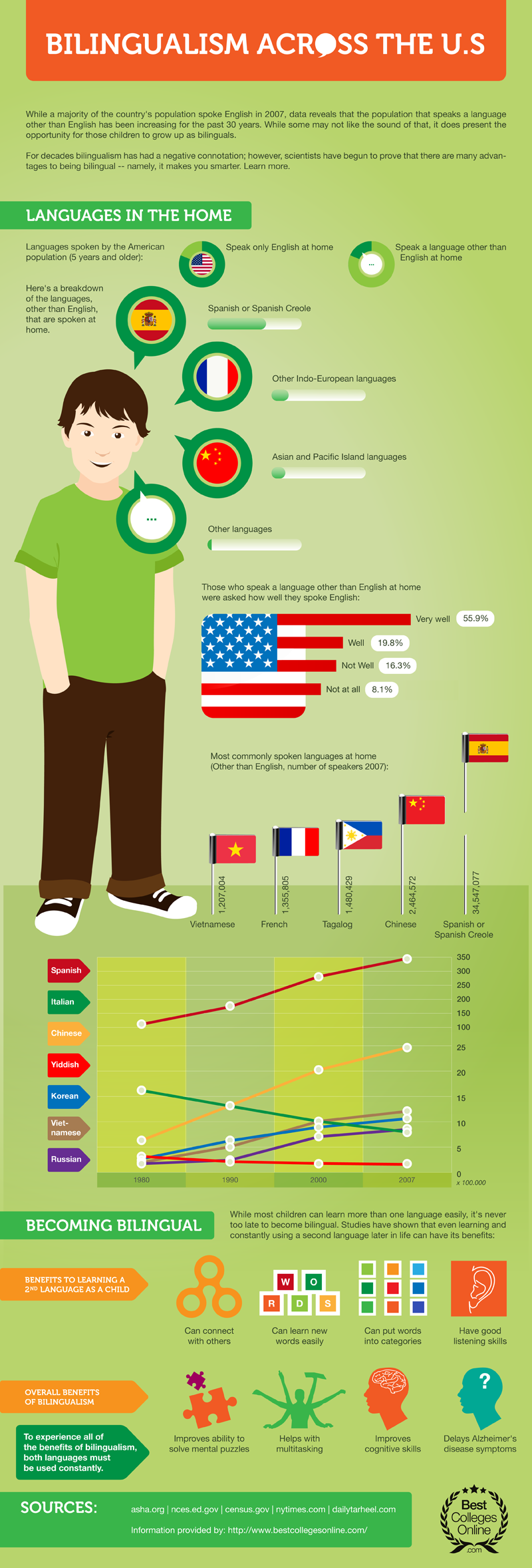
 As we are settling into our life in Bangkok, we have started to try to find a Latin community in which to embed ourselves. This has proven to be quite a challenge. At the same time, I was sent a fun info-graphic on the state of bilingualism in the United States and it really drove home both the opportunity I missed in perfecting my own Spanish while I lived there, as well as giving up a rich Latin community for my girls.
In the same week I received the info-graphic, I was sent an article on 10 reasons why every child should learn to speak Spanish. Now I feel I should mention some caveats here since this is clearly a US-centered article and many of the reasons listed are general benefits of bilingualism vs. benefits specifically associated with Spanish. Also worth note is that Spanish is not the official language of the United Nations but one of six, the other five being Arabic, Chinese (presumably Mandarin), English, French and Russian. That said, the article, coupled with the info-graphic makes a strong case for choosing Spanish as your child’s second language in the US. More importantly, it is a reminder to look at the resources around you such as immersion programs and the cultural makeup of your community before making this kind of choice. Maybe Mandarin and Hindi are the languages of the future global economic super powers but if you don’t have ample support available, another tongue may be a better choice.
If you are going to plant the seed, you may as well try to have the best soil, light and water conditions available for growth! And now I must return to stalking innocent Spanish speakers on the streets of Bangkok.




 Multilingual Mama