I Did Not Screw Up My Child Today.

Many of you have kindly followed me through my language neuroses and in particular, Pea’s ‘will she, won’t she’ speak French. We made the decision to bleed ourselves and send her to the Lycée Français International de Bangkok, or LFIB, for a few reasons: the fact that she wasn’t speaking French (though she understood it), my lack of self-confidence in homeschooling—especially in French—and no other affordable schooling options.

Choosing the LFIB was only the first step as the Lycée now offers a bilingual Franco-English program. Yet another decision I could spend hours debating—am I the only one developing a serious phobia of too many choices? We discussed our language profile with the head of the elementary school and, after hearing my grammatical errors, observing hubby’s near lack of French and being told that Pea was currently in an English/Mandarin nursery in Singapore, he was adamant that she be put in the monolingual section. He also begged us to stick to OPOL (One Parent One Language) as, from his experience, this worked best with consolidating languages for the kids under his care.

After Pea completed her first week, her teacher kindly wrote me an email reassuring me that she seemed to be settling in very well. She also queried Pea’s language skills as she had been told Pea spoke French but none was forthcoming and no matter the situation, Pea insisted on responding in English. Her teacher, like the director, emphasized the importance of my using French around her and ask that I encourage her to speak it.

Nearly three months have passed since Pea’s first day at the French Lycée, and school will be wrapping up shortly. I’ve quietly envied the French parents who will be putting their children in the bilingual section next year as I’ve increasingly come across articles extolling the virtues of bilingual immersion programs. In a way, I’ve enjoyed knowing she was getting so much French as it meant I no longer felt as guilty when I would pull out The Gruffalo or another English language story.

I resigned myself to the situation when an game-changer makes its way into my inbox.

The admission criteria for the application in the bilingual section have been voted in the School Council on 2nd April 2009. According to these criteria, the cycle 1 teacher’s council has announced the admission of your child in bilingual Moyenne Section for the next school year starting on September 3rd. In order to validate this decision, it is necessary to send your answer (before june 14th) to let us know whether you accept your child’s admission in the bilingual section.

I read the mail. I read it again. And one more time for good measure. I think this must be some sort of mistake, probably something they sent out to all parents. I walked away from my computer. I walked back. My stream of consciousness as I sat down in front of the screen:

hmm maybe they really think Pea should be in the bilingual program…who are you kidding, she still reverts to English constantly. Generic email. This is a generic email. They charge more for bilingual program and they just want to increase funds in the coffers. But maybe…maybe I should put her in the bilingual program. I have read all these articles talking about how wonderful immersion programs are for kids. And what if I can’t afford to send her to the Lycée one day? What if I have to put her in an English-speaking school? She would be better off if she’d had some tuition in English…

My head spins

I am ruining her. She won’t ever speak proper French or English because of me. Look at all those cute, sophisticated, snarky and/or surprising quotes everyone’s kids are making. Damn you Facebook for driving home the fact that I suck as a parent and I’ve ruined my kid….I need more warm chocolate cake and chocolate sauce to help me forget what a failure I am.

I gave myself a much-needed figurative smack to jolt me before I spiralled out of control. I told myself I should rule out the bilingual option definitively by checking with the Director directly.  I drop him a quick note confirming the email was sent by mistake and, given her French, could he please confirm that we should be enrolling Pea in the monolingual section.

Yesterday my computer chimes. I’ve got mail. [Remind myself to figure out how to turn off annoying notifications.]

In my inbox was an email from Pea’s teacher. In short she said the following:

  • Pea tested extremely well in her French assessment (54/57), much higher than many kids who would be kept in the monolingual section to help them consolidate their French.
  • Pea has made enormous progress, now speaking in full sentences with a good working vocabulary.
  • We feel Pea has the right profile for the bilingual section and that it would be an optimal environment in which she will flourish.

‘Holy Crap’ I thought to myself. ‘I must not be reading this correctly.’ Then I realized I was, and for a moment, about 19.5 hours to be exact, I felt a joyous combination of pride, excitement, relief and a belief that I wasn’t screwing up my child.


Fast Food Showdown: A Singaporean Reflection

When we started looking into moving to Southeast Asia, specifically Singapore, we were lucky enough to have friends of friends we could talk to about what to expect. My approach to mining these valuable resources made mountaintop removal look gentle. I will be forever grateful for the long email exchanges and Skype phone calls various folks endured, where conversations were more akin to military interrogations.

Towards the end of one of our marathon calls, I was really surprised by something a mama friend told me. She said that if given the choice between a Saturday treat of McDonald’s or chicken rice—a Singaporean staple from the hawker stands, their version of fast food that is NOTHING like fast food as we know it—the kids would choose chicken rice every time. I had trouble believing this on a number of levels.

This post was written for A is for Manzana, my blog on In Culture Parent. To continue reading please click here.

Karambolage: Factoids and Language Learning Bliss

Karambolage: Factoids and Language Learning Bliss via Slate.

Forget naff exchanges about the weather and where the bank is located. These dull as dishwater language basics may be tried and tested, but the end result, as far as I can tell, is a big fat FAIL.

Instead, check out this fabulous program Karambolage. It is made up of superb animations and covers fascinating topics like the origins of Cordon Bleue or how bunnies and eggs became associated with easter.

Drawbacks? You need to sit patiently through the annoying 40 seconds of disco beats and a dismembered head floating around a black screen. Seems like a short amount of time but trust me when I tell you it feels like an eternity. (Disclaimer: part of this could be my sucky wi-fi connection). It is also only available in French and German.

Enjoy!

Comic Sans MS: Wrong in Any Language

This post is dedicated to my very fabulous friend and designer Fil Vocasek who helped me sashay through the world of fonts.

I’ve been thinking about fonts and no, I am not a designer. In fact, up until I worked with designers, I had never really noticed the existence of fonts on a conscious level. Now, I have yet to find my perfect match and often long for the days of my blissful unawareness.

So why was I thinking of fonts? Well it has everything to do with this crazy idea of mine to learn to read and write Thai. This little project is for the most part going rather poorly. Lack of sustained attention and other more pressing issues have been getting in the way and I’ve just taken a 3 week break from my class which is to say I’ll be back at square one when I resume classes next week.  That said, I have learned all the basic consonants and vowels — all 44 of them—  and in a bid to try to keep these fresh in my mind, I’ve been looking at signs and storefronts when my taxi sits idling in traffic. Given that I live in Bangkok, this happens a lot!

But I am getting ahead of myself. The way I was taught the letters at my  Thai School was 3 fold:

  1. We were introduced to small groups of consonants and vowels that shared certain characteristics like being high or low, short or long, and paired them together in both writing and pronunciation. There was a lot of repetition involved writing out the letters.
  2. We also spent  time reading them out  across, down and diagonally in table form to try to avoid learning the sounds by rote.
  3. Finally we would finish with dictation of the actual alphabet followed by groups of sounds like bapadosila. 

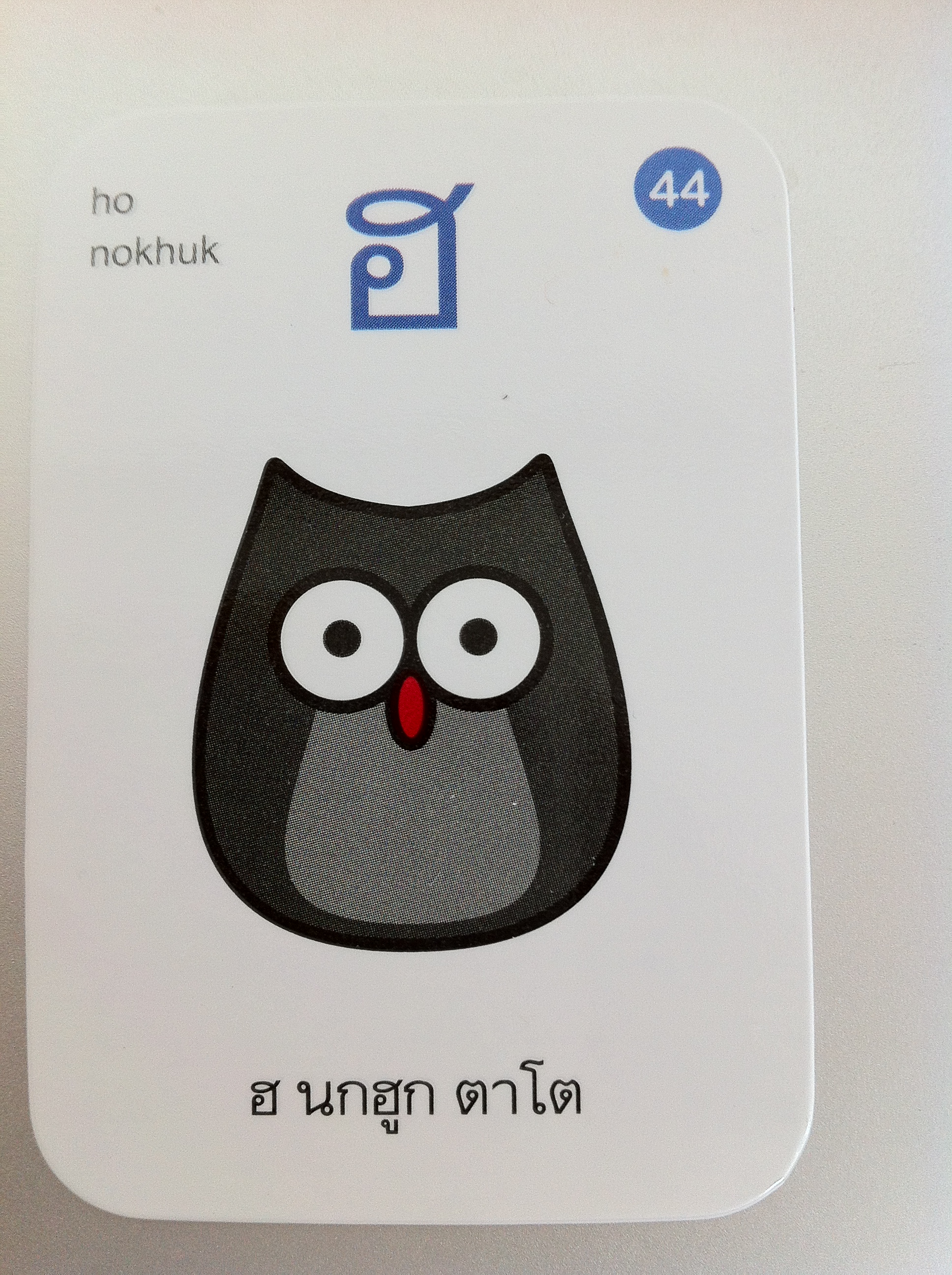
Another form of quizzing came in a flash card format:


My teacher would show me a card and I would have to respond with the name of the letter. Here is where the trouble began. Look at the picture above. This letter is a low-class consonant called Ho. And yes, even letters have classes here in Thailand.  The thing is, when I learned this letter, its bottom was curved like an O, not square. To make matters worse, there are other letters that I’ve been taught with square bottoms that I now come across in a font where they are curved or edgeless.  Having dutifully studied, I was none too pleased to find myself  failing the quiz by not recognizing letters due to font issues. “Foul play!” I cried,  having not gotten over needing the affirmation of good grades. Pathetic…I know.

This is how I got to thinking about fonts and the role they play. See, until now, fonts may have been, on occasion, a serious affront to my senses —honestly, how does anyone still use Comic Sans MS these days? <she types ignoring the fact that she once actually had her CV in that font>—  but apart from the pain to my delicate eyes, things were always legible.

Now when I’ve sat in my taxi in traffic, I think I might have understood…actually that is very ambitious so let me rephrase that…I might have deciphered the letters, but for whatever reason, like trying to stand out or a sale on really bad lettering, most of the signs and awnings are totally illegible to me. It simply takes too long to figure out what has been done to the letter for me to figure it out, even in Bangkok standstill traffic.

It will come as no surprise then that I was interested in learning that  Nokia has designed a new font that will work in any language, which must actually be more difficult than it initially sounds. I am also saddened by the fact that I’ve just written a post on fonts. Seriously, how boring is that? Kudos to anyone who actually made it through this post in its entirety.