Night and Day, and the Alphabet

A new friend who is expecting her forth explained to me one of her rationals for having more than two kids. It goes something like this: If you just have two, it’s too easy to fall into categorizing your kids good/bad, generous/selfish, gregarious/quiet, etc. She claims that with three or more, it ends up being more of a merry-go-round in terms of who is acting up which leads to less labeling.

It’s an interesting concept and I loath to admit that I find myself doing exactly this. Among the dichotomies, they are divvied up as verbally gifted and the late-speaker. Some of you may have read my timeline post on the early days of P’s language emergence; it’s called: when self-doubt creeps in.  The title is quite the giveaway. There were times I wondered if she was ever going to speak. If felt like forever and this is due, I am sure in part, to the fact that her two best buddies were seriously early and prolific talkers. They were singing full songs before P could put two words together.

I spent a lot of time seesawing between believing–and explaining to everyone who raised an eyebrow–that some kids are just late talkers irrespective of the number of languages spoken at home, and entertaining the fact that maybe it was the three languages but that I should hold tight as she would eventually catch up.

I’d read that children in multilingual households were often a bit slower to speak with more limited vocabularies but they usually caught up and surpassed their little monolingual mates. Hurrah  By the age of 2-3….err wait my kid only has about 80 words and that’s including water in French, English, Spanish and ASL. If you cut it down to just meaning, she had about 20 words.  I’d also read that there was no difference in the development timelines and heard stories of children–actually my little cousin was one of these–who speak on time, well and in all of their languages. My best friend had often repeated that she knew a tri-lingual (Japanese, French & English) family whose first daughter had no speech issues while her little brother was an extremely late talker for whom they sought expert advice.

All this to say that from the time that C was 10 weeks old, I could already spot the difference. As a baby she vocalized a lot just as all those annoying parenting books said she would. P never did. She watched everything attentively but overall, she was, with the exception of crying, a very quiet baby. She was definitely a prolific smiler but laughter took forever to happen. For a while, I was worried that I was the least funny parent on the planet. All my ‘new-mothers’ group friends were posting cute YouTube videos of their babies chuckling and gurgling and all I could get at best was a gummy smile. Sometimes it was if she was laughing silently.

C did end up quieting down a bit and I figured I had another slow talker on my hands.  Her babbling was done rather quietly. Some first words came – the usual for babies these days: Mama, Papa, iPad, Milk but nothing out of the ordinary and not at an accelerated rate. These were said loudly and confidently but the rest of her babble was more of a mumble.

Then out of the blue, around 18 months, when she was using a handful of words and signs but not much else, she started speaking in sentences. And by sentences, I don’t mean

“Give milk me” or “me want biscuit”

but things like

“I want to sit there” and “no, I don’t want that”

The first couple of times I told my husband I was clearly hallucinating as I could have sworn that C was speaking in grammatically correct sentences. She was still in her barely audible phase so I was certain I was mishearing. But then in happened when he was there. And we both looked at each other and then I knew, it wasn’t just wishful thinking.

Claude also spoke more readily in the various languages though here I attribute this in part to me making a much bigger effort at sticking to French and that she started attending a bilingual French/English program, something we were not able to provide for P at the same age. She also had that vocab explosion most kids have where they repeat every single word or phrase they hear.

And at the age where P finally put “hi” and “mama” together, C was giving us full renditions of twinkle twinkle little star and her absolute favorite, the alphabet.

Everything in due course. Children develop at different speeds but they all get there eventually. C sang at 2, P didn’t sing til around 3.5. In this age of  league tables and measurements and researching everything to death, when we bathe in an environment rife with hyper-parenting, drowning in endless streams of activities there to amuse our children but more often to assuage our fear of not doing everything possible to give our children the best start in life, it is very difficult to take a laid back attitude and just let kids be kids. But it is critical for our kids wellbeing and more importantly perhaps our own that we take a step back, slow down and let them develop at their individual pace.

My girls were night and day when it came to their language development but now, I sit here, sweetly serenaded by the pair and realize I need not have worried so much.

This post was written for the October Bilingual Carnival, hosted this month by Bilingual Babes.

It’s a Polyglot World Out There.

Shhhhh Maman…you know when I speak to Suu in French, she doesn’t understand.

P whispered to me as we were cuddling a moment, catching up on the day’s events before I initiated the last steps of our nightly routine and sung her a lullaby.

I couldn’t quite pin her tone and expression. There was an air of complicity of sorts in sharing someone’s shortcomings. And yet, her physical expression changed to one of disinterest and the tone changed as she expanded a little on the topic. Finally, she ended up seeming genuinely concerned, even bordering on feeling pity.

It should be noted by readers that Suu is our wonderful Burmese helper (Yes I am spoiled ROTTEN!) who, in addition to her mother tongue of Burmese,  speaks Thai fluently, is learning English, having a decent working conversational level now. She also takes additional classes to learn how to read and write Thai. And on top of this, she is picking up French words the girls seem to favor for certain items or actions.

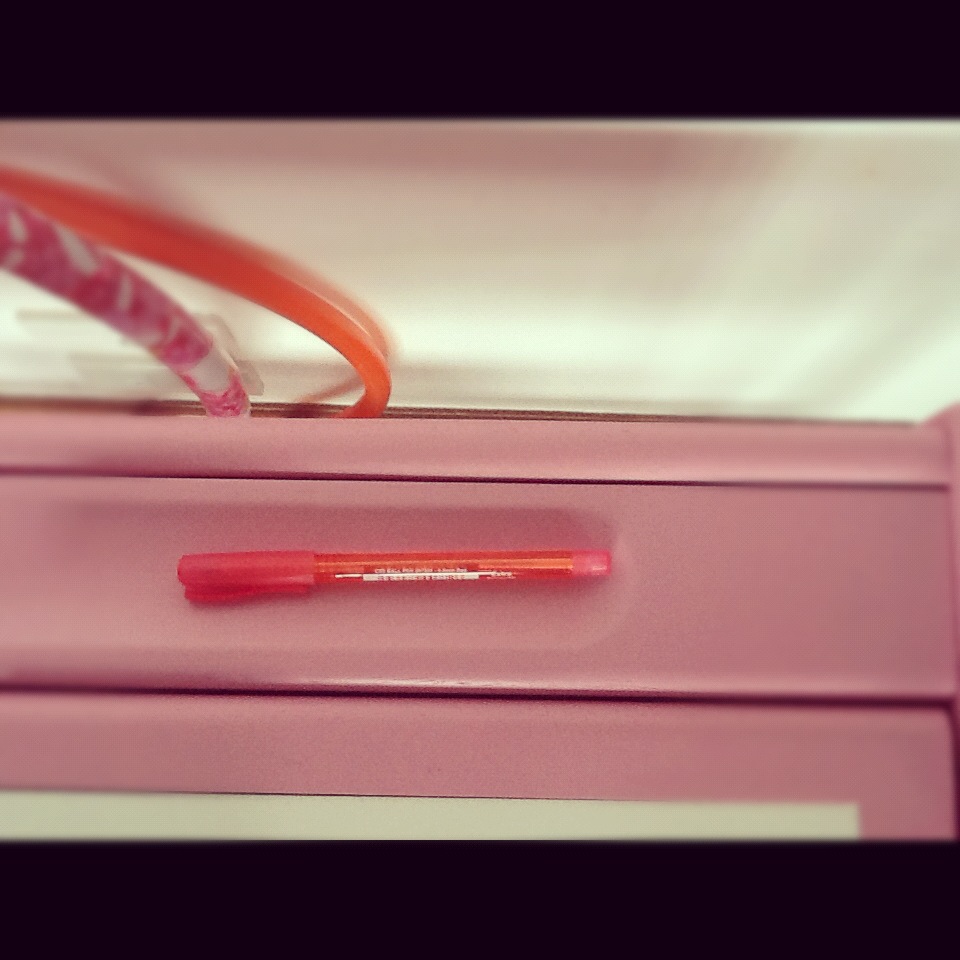
Rewind to earlier in the evening: I was trying to get something –I can’t tell you what at this point–done in my room and could hear that pitch. You know the one, increasingly grating, whininess and volume rising exponential with every passing complaint. P was hunting for her pink ‘stylo’. Suu, unsurprisingly, didn’t know that the word stylo means pen. It was the end of the day, P hadn’t eaten yet, she was tired, cranky, hungry and about to pitch a tantrum.

The Culprit


These types of misunderstandings are only one of many little wobbles we multilingual parents face. Agile in negotiating these small but treacherous rapids, I acted as any sane human would and jumped up to intervene before we hit DEFCON 1. While stumbling into the hallway, I shouted out to Suu, translating stylo, also letting her know where I last saw P using it, since she is still at an age where ‘looking for something’ entails her walking around with her eyes wide shut assuring me she is looking everywhere as she passes right next to whichever desired item is currently misplaced.


Over the summer, I’ve really noticed P’s awareness of different languages and in particular, how useful it is to know more than one language since she regularly encounters adults and children who readily switch back and forth in any number of idioms. More importantly, she has been taking note of people who end up lost, confused or simply left out when they can’t join in. I’ve also been very vocal about my desire to speak Spanish and Thai fluently and have made an effort, when appropriate (force feeding never got anyone anywhere, except perhaps for some delicious foie gras), to talk about my classes, teachers, homework, triumphs and gaffes.

Knowing this, I decided to point out the barrier:

Ma Cherie, Suu ne comprend pas le mot STYLO. C’est un mot français. Le mot anglais est PEN. Tu dois faire attention et lui parler en anglais car elle ne parle pas français.

Translates roughly to: Darling, Suu doesn’t understand the word STYLO. It’s a French word. The English word is PEN. You need to be careful and speak to her in English since she can’t speak French.

And yes the lack of capitalization in the French quote for languages is grammatically correct. English is also the only language that capitalizes i. Interesting article here on the subject.

It dawned on me that the stylo incident is what drove home the notion that Suu didn’t speak French and why she presumably shared this revelation with me that evening. We will look past the fact that I had pointed this out to her 90 minutes earlier.

Since then, P has made a point of declaring which languages various friends and family speak. Yesterday she told her best ‘boyfriend’ Lucas, a Franco-Chinese boy who speaks French, English, Mandarin fluently, that her father speaks a lot of ‘Español’.

This is the first time she brought up Spanish of her own accord. The seed is definitely planted. Here’s to hoping the nopal blooms!

—-This post was written for the September Bilingual Carnival. This month’s carnival is hosted by All Done Monkey and will go live September 27.

Now For Sale: Daughters, $10,000 Each (If They’re Pretty)

I dedicate this post to my daughters. This is an amazing poetry slam performance. Kate Makkai, consider me your fan.


From My Thai Ashes, A Spanish Phoenix Rises.

Yes, I am prone to exaggerations. My Thai is hardly a mound of ashes, though it did come remarkably close to one in the last couple of months. With our future in Bangkok an uncertain one, and a host of other worries on our plates, I’ve been a very naughty language student.

Utterly unmotivated, I should have put my classes on hold and gifted them if we ended up leaving Bangkok. But hindsight is all too often useless. Instead, I attended here and there, wasting precious hours and retaining absolutely nothing, nor really maintaining what I had. Shame on me.

I’ll omit the self-berating monologue that has been on repeat play in my brain. It just isn’t productive. And when I can shut it up for a time, this has been an extremely valuable lesson in why one should heed Horace’s advice: Carpe Diem, imbedded into my generation’s brain by the inestimable Robin Williams.

You see dear reader, once I knew we were staying here and I had no more bahts to pay for classes when my package ran out, I realized how much I’d wasted. I’ve since really put some effort into getting my Thai back on track. What surprised me the most wasn’t just the renewed and strengthened desire to speak Thai; it was the realization of all the missed opportunities I’ve had over the last fifteen years to perfect my Spanish. (Read: speak in anything other than the present tense).

I worked for a Spanish-speaking employer for nearly five years along with his sister and his Spanish wife. Over the course of my employment there, I had two Spanish colleagues and most of our clientele was from Latin America and Spain. My mother and eldest brother are both fluent in Spanish. My godfather is from Argentina, and I’ve been together with my Mexican husband for nearly ten years. Seven of those were spent in NYC, often in predominantly Latin neighborhoods. Spanish is the second most spoken language in the US, as was widely evident in my double-period Spanish class where most of the students already spoke Spanish at home.

It bears repeating. My husband is Mexican. Seriously. I live with a fluent Spanish speaker. Say it with me slowly: S-H-A-M-E. Go on, you can do the forefinger rub. I deserve it.

I can give you a million and one reasons why I haven’t improved past advanced beginner, and some of them are actually as pretty good. But the truth is, I have no excuse.

When I picture myself in my dreams, as the person I’d like to be,  I am always able to navigate flawlessly through Spanish conversations. I’ve held off reading a host of wonderful Spanish writers in the knowledge that someday I will read them in their original form. I see my children, who are half-Mexican, telling their Abuelita about their week in Spanish on weekly calls. And I see myself calling her to catch up and tell her all about her grand-daughters lives and get sneaky ‘home-cooked’ mexican recipes to surprise my husband.

None of this will happen, if I don’t get off my ‘nachas’ and do this. I owe it to myself, I owe it to my extended family and, most of all, I owe it to my daughters.

All rights reserved by Tessek. Via Flickr