Teachable Moments: Pillow Math & Other Opportunities Abound.

We are finally back from our big adventure at PunPun, a sustainable farm one hour north of Chiang Mai. Our stay was spectacular in so many ways and I will be writing a more comprehensive post about our time there. Here’s a sneak peek: Photo by my 5-yr-old

PunPunFarm Kids CC

While I am still catching up on the backlog of emails and commitments after an amazing break from wireless and unlimited kbps lands, I want to share an important lesson I re-learned during our trip.

Teachable moments are everywhere.

Sometimes as homeschooling parents –based on my vast experience of stalking online groups– we worry we aren’t giving our kids enough, that we aren’t prepared enough, that we don’t have all the things we need in order to teach them what they need to learn. When I started out this year, I was obsessed with lesson plans, curriculums, and having the right manipulables. I worried how I would manage with a limited budget. (Read anyone who wants to donate or gift me a Montessori moveable letters set, don’t hold back!) But in truth I was worrying for nothing; some of you may already have realized I could get paid for worrying, I am such an expert at it.

When I stopped trying to bring school home and let go, things naturally started to happen. Once I was fully oxygenating my brain instead of panicking about how much I was covering and just watching my kids play, I could jump in when they asked and see where I could naturally fit in letter, number, language learning among other things.

Here are a couple examples:

1. From a morning chat to vocabulary building & basic math concepts.
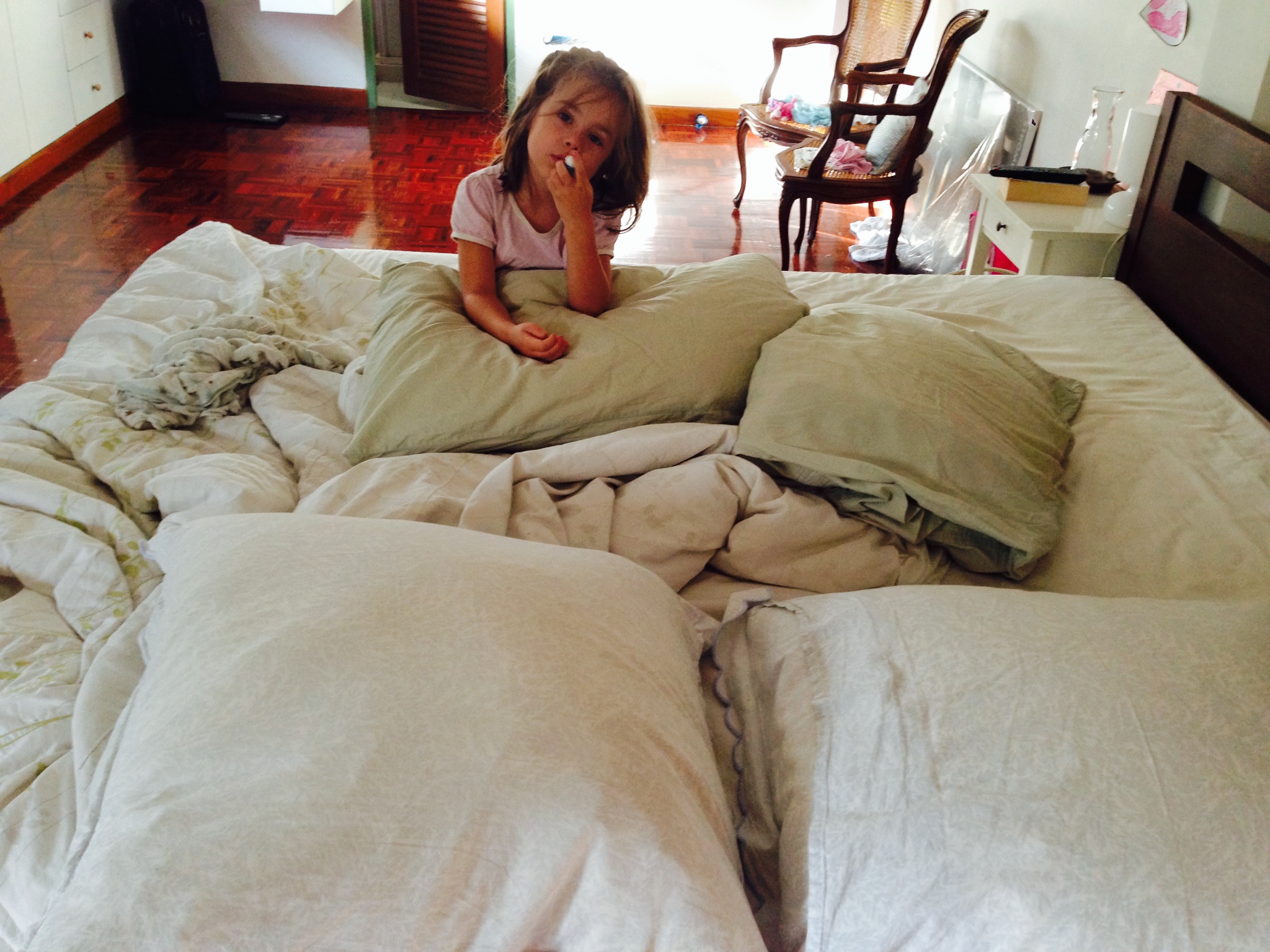
Mondays are French days in our house and I was talking with P while halfheartedly trying to make my bed. I am not sure how, but I used the word plus in French, meaning which means both more and “+”. My daughter asked me to explain the word. I used moins or less as a contrast but it wasn’t enough for her to understand. Finally I looked around and grabbed the four pillows I was fluffing. We divvied them up a few times, with her having more and then less than me.  We talked about adding them to her pile. We also had equal amounts. I then talked her through other verbal examples of more or less things, like who got to hold the chicken more at the farm, etc. Finally we found a pen and paper and looked at the + and – signs and wrote out the basic pillow additions we did. Ending the lot with a small pillow/tickle fight.

Teachable: Pillow Maths

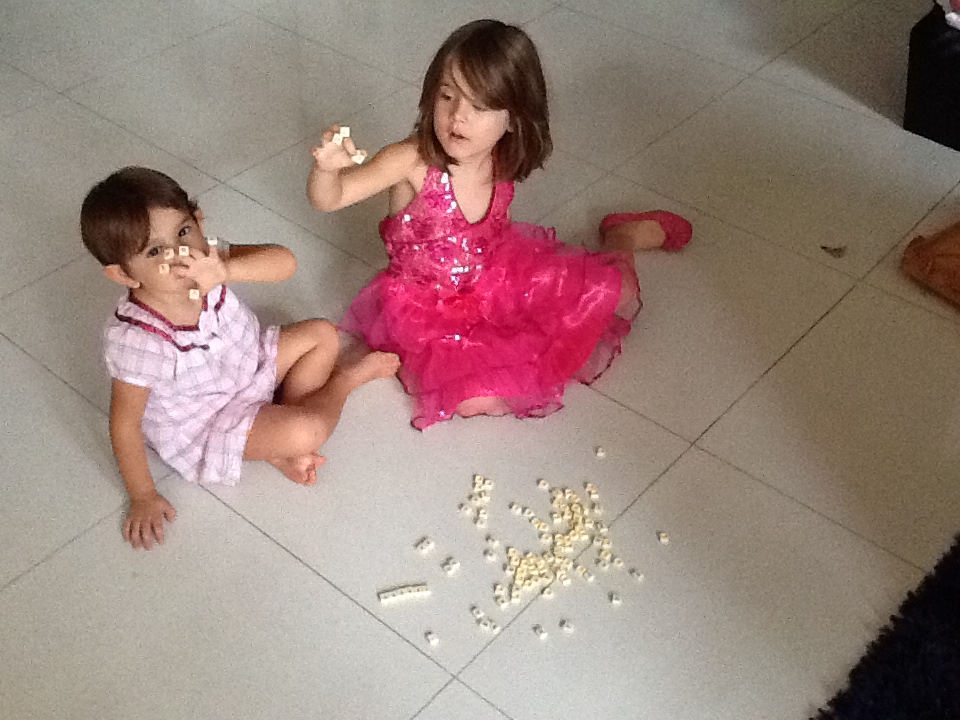
2. I wanted to review some letters with something other than paper letters. As I was re-organizing toys, I came across a travel scrabble set we have yet to use. The girls loved grouping similar letters. Then counting how many of each they had and then putting them into order. Yes the star and pink boxes distracted them briefly, but hey, it’s all a work in progress.

Teachable, Scrabble Letters Alphabet

And yes, we always play scrabble in pink ballroom competition dresses. Don’t you?

I’ll put more examples in the comments as they crop up. I am just so tired I can’t think of them now. And please share your own!

Speech Development: Keep Calm, Your Toddler Will Talk

Children learning to talk

Keep calm, you kid will talk.

I know it doesn’t feel that way. I know when faced with your kid’s precocious eighteen-month-old friend who is already stringing sentences together and using words with more syllables than you can manage after another-sleep deprived night, you will feel like you have failed.

This happens to all parents mono or multilingual, though those trying to raise multilingual kids are often actually subtly –or not so subtly– accused of bringing this on themselves. (Which, for the record, is supported by zero research. But who needs research these days?)

The nasty voices that never seem to go away will be haranguing you:

It’s your fault, you shouldn’t have gone back to work.

You should have spent more time describing every small detail like: watch mommy unscrew the cap on the tube of Preparation H – that’s hemorrhoid cream. Now squeeze the tube and apply a small amount to your index finger. See my index finger? And then gently rub…I’ll leave you wondering whether it’s for sagging eyes or sagging innards.

I shouldn’t have stuck her in front of Baby Einstein when I was showering, cooking, walking the dog –yes walking the dog but I assure you she was well strapped in.

You suck as a parent.

Did you really believe you could bring up a multilingual kid? It’s your fault, forget all the studies that say a kid will just develop speech when they are ready and listen to the uptight mother at the Pediatrician’s office who simply ‘knows’ your kid is still stuck on mama and bye-bye because you speak another language to her.

You should have read more, talked more, jumped up and down in a hoop while juggling pacifiers…

You are just innately stupid as you have long suspected and now that is manifesting itself in your offspring.

I am hoping your voices aren’t nearly as vitriolic as mine. I spent hours perusing websites, buying books on encouraging speech, learning sign language, and of course keeping a positive face in front of all of those wondering why my kid still barely uttered a few words.

And then it happened. She started talking. The floodgates opened and I sat, immersed in the tidal wave of words, elated –for about 48 hours before the  very awful thought crept into my mind”

My God, when is she ever going to stop? She is the Duracell bunny. She just keeps talking and talking and talking and talking and talking…

Careful what you wish for.

Keep calm, your kid will talk. And then they will never shut the f*%$ up.

This post was written for October’s Raising Multilingual Children Carnival, hosted by Discovering the World Through My Son’s Eyes. It will be going live Monday October 28th. Please check out all the wonderful submissions. Of course, had I been organized and realized this month had a specific topic, you’d also find my post there. Of course, you won’t.  Welcome to my world.

Living with Pigs. Taking Media One Step Too Far.

peppapig muddy puddlesThis post is written the October Multilingual Kids Blogging carnival hosted by one of my favourite blogs The European Mama . The theme this month is Media. I see various forms of media as tools. And like all tools, they can be wielded skillfully and help you build something, like using a hammer to mount a blackboard. Or à la Trinity killer, you can use it to crush someone’s skull.

I apologise for the graphic nature of the last sentence but that’s really it. In most cases, it isn’t that extreme, it may just be a black and blue fingernail, but one should always think carefully about what the purpose of the media is and what you hope to achieve with its use.

When I first found myself incubating a wee one, I thought “yes, I’ll abide by The American Academy of Pediatrics’ advice and not allow my child any television before the age of two.” Then, as the stench wafting from my un-washed armpits caused my husband to dry heave when he made it home, reality set in and my desire for regular showers led me to rethink my decision. Perhaps a few soothing Baby Einstein videos wouldn’t be so bad. (AND no, I never thought nor cared for my child to be a genius. I am more of an ‘ignorance is bliss’ kind of gal). No more than 10 or 15 minutes top, I swore to myself.

Ha, as if. There’s a reason all these DVDs have a repeat button on them. And we all know kids love repetition!
peppapigblogrepeat

I’ve always been one to rationalise. Our brain’s ability to create reasons to justify what we need never ceases to astonish me.  I convinced myself the one way I could ensure adequate exposure to all three heritage languages was through the use of DVDs, programs, songs, etc.  I knew that providing enough language exposure would be a challenge. And a few “Rue Sesame” episodes seemed like just the ticket. No better excuse to pop your kid in front of the boob tube.

As it turns out, my first child was a late talker and I am a worrier. I know you say all parents worry. But I fall on the extreme end of the spectrum. I cross a street by myself and see visions of an 18 wheeler careening around the corner; I’ll leave the rest to your imagination.

Secretly enjoying the use of TV —insert whatever gadget you wish here as this all started pre-iPad—  I figured if I only got programs in Spanish and French, then any TV watching would be educational and furthering my goal of language acquisition. This seemed like a big win-win for all parties involved.

With the right discipline, or I should say wielding the tool appropriately, this would have been fine. But I couldn’t stick to this regime.  All sorts of cute programs were on and I couldn’t find French or Spanish equivalents. We got rid of cable television so I would stick to DVDs. This worked for a time. Living in Brooklyn with so many spanish speakers, most DVDs had a spanish option but once we moved to South East Asia, Tamil, Mandarin and Korean were more likely language options than Spanish or French.

Then there was the problem of programs being translated but not really culturally appropriate. Sesame Street in French should really be something like Rue Roblochon. And a Spanish Peppa Pig would not be talking about gardening all the time. Maybe siestas? Or long lunches with chorizo? OK maybe not a pig eating pork sausages…

I simply gave up making an effort for a long time and showed them predominantly English programming.  Perhaps I am also admitting that my house is full of TV addicts. And yes, it’s entirely my fault, along with some prone-to-addiction genes handed down. Hindsight is always 20/20. If I am honest with myself,  I always knew there was a problem but chose to suppress it effectively, as so many other things, for the sake of convenience. Until now.

This is the year I’ve started homeschooling. One of my goals, in preparation for their big summer in Mexico next year, is to ramp up their Spanish. Normally if the kids see anything in English for the first time, it is nearly impossible to persuade them to watch it in another language.  With one exception: Peppa Pig. They worship before the altar of this little pink porcine diva.  So desperate are they to watch Peppa and George jump in muddy puddles, they will take it in any language. A newly created Spanish version is my saving grace, despite the Castilian ‘c’ pronunciation -sacrifices must be made!

With this discovery, I was permitting more TV in order to get the girls hooked. Requests for Spanish programs rose and I heard a lot of I can’t wait to speak Español. Here’s the thing: the Spanish program was great, but too much of it wasn’t. Soon, every morning, before I’d even opened my eyes, I’d feel a little finger jabbing my shoulder and a small whispering voice… “mama, can I watch a movie? please? please? please? please? Some Peppa?”.

Despite my emphatic NOs, she continued, laying on the charm thick and fast. Even saying “but I want Peppa Español mama, pleeeeease?”

One night I was putting C to bed. She’d actually watched a bit of Peppa before her shower and had her bedtime story. The lights were off, we were cuddling, and I asked her, as I always do, what song she would like me to sing. Her response? she whispered sweetly: “A movie mama. Can I have a movie?” After about five offers to sing a song, I just kissed her goodnight. I wouldn’t be entirely surprised if she fell asleep the words ‘movie’ and ‘Peppa’ still on her lips.

It doesn’t take a genius to figure out we needed a major intervention; that I’d used the idea of media as language reinforcement instead as ‘a buy mama x amount of Facebook minutes’, or homeschool lesson planning or whatever other black hole of activity that seems to be sucking up all my time these days.

Instead of genuinely creating a plan, using all the tools at my disposition to create an enriched linguistic environment, I fell into a classic case of plonking kids in front of TV for some peace.

I normally spend hours, no weeks and months beating myself up about these things, but it’s pointless. Instead, I’ve just instituted a clean break. Time for them to reconnect with other things, like the muddy puddles in the yard from the endless rainy season downpours, while I strategize on how I can use these things constructively and in moderation moving forward.

I’ll leave you with my favorite exchange of the week:

Me to P: ‘ello gorgeous!

C to me: NO! I’m gorgeous!

Me to C: of course, you are both gorgeous!

C to Me: No, P is Peppa pig and I am Gorgeous. (aka George)

Mystery revealed. And time to cut down on Peppa episodes. The giveaway should have been being greeted as Mummy pig a few mornings prior.

P.S. What’s the attraction with cheeky pigs?
How Learning Yoga is Similar to Learning Another Language

I’ve finally started homeschooling and it hasn’t gone as smoothly as I’d hoped though I was told to expect this. So here is a big shout out and thanks to the lovely  Giselle Shardlow  for her guest post this week. Giselle is the author of Kids Yoga StoriesHer yoga-inspired children’s books get children moving, learning, and having fun.  She draws from her experiences as a teacher, traveler, yogi, and mom to write her stories found at www.kidsyogastories.com or on Amazon worldwide.

How Learning Yoga is Similar to Learning Another Language

I’m so excited!  I’ve recently had a fun aha moment.  It occurred to me that teaching yoga is a lot like teaching another language.  As parents, we explore this connection as we raise our daughter to be a yogini and Spanish speaker.  I recently wrote about how integrating yoga and Spanish is a perfect combination.   I would love to share with you how we teach our daughter yoga and Spanish at the same time.

Ways to approach teaching both yoga and Spanish

As a stay-at-home mom to a two-year-old daughter, I’m constantly thinking about how to create an effective and engaging learning environment at home.  As we continue along our journey, here’s how we foster our daughter’s love of learning both Spanish and yoga:

  • Share an experience or have another close family friend share one
  • Make the learning fun, engaging, light-hearted, and interesting
  • Cater to her interests, such as animals and nature
  • Create a consistent, daily ritual of learning (for example, spend five minutes a day)
  • Practice positive reinforcement
  • Make the learning meaningful and relevant to her life
  • Learn through activity and movement
  • Encourage her self-expression, and increase her self-esteem
  • Start with the basics (for example, animal poses for yoga and counting in Spanish)
  • Build memory skills through repetition
  • Foster an active lifestyle for her mind and body
  • Start early, and start simple
  • Create an effective and rich learning environment
  • Show passion and excitement for learning
  • Notice her mood on that day and adapt accordingly
  • Cater to her multiple intelligences through language, physical activity, sounds, nature, music, interpersonal connection, and visuals
  • Use a variety of media, such as books, CDs, videos, cards, and games


spansh resources all rights reserved 

How to integrate learning Spanish and practicing yoga

Downward-Facing Dog was our daughter’s first yoga pose.  She practiced it literally everywhere and anywhere.  Next, she learned the Tree Pose.  Now, there’s no stopping her.  She’s hooked.  Just recently, we started Spanish Yoga.

This Sun Salute sequence or each pose separately is a good place to start practicing.  Note the keyword in English and Spanish, along with the matching kids yoga pose:

  1. Mountain – La Montana
    Mountain Pose

Stand tall with your feet together and your arms by your side.  Take a deep breath.  Ahh!

  1. Sun – El Sol
    Extended Mountain Pose

Stand tall, reach your hands up to the sky, and look up.  Hello sun!

  1. Waterfall – La Cascada
    Standing Forward Bend

Bend forward at the waist and reach for your toes.  Whoosh!

  1. Frog – La Rana
    Garland (Squat) Pose

Come down to a squat with your hands between your feet. Then jump up like a frog.  Ribbit!

  1. Snake – El Serpiente
    Cobra Pose

Lie down on your belly, place your palms flat on the ground next to your shoulders, lift your head and chest, and look up.  Hiss!

  1. Dog – El Perro
    Downward-Facing Dog Pose

Press back to your hands and feet, then bark like a dog.  Ruff!

You can say the instructions in Spanish to enrich the language experience.  Also, ask questions as your children move through the poses.  How do they feel?  Can they imagine being that animal?  Can they think of other animals to act out?  Encourage their creativity and exploration.  Focus on having fun, not on perfectly aligned poses.  Model the poses with enthusiasm.  Play Spanish music.  Wear comfortable clothing and practice barefoot.  Enjoy yourselves.  Allow for spontaneous learning moments.  Follow their passion.  Yoga and language learning are lifelong journeys, so embrace the experience.

A picture of our daughter practicing the Tree Pose while “counting” to ten in Spanish.

 treepose all rights reserved

The yoga poses in another language

For older children, yoga is an opportunity to be exposed to yet another language. Below are the yoga poses along with the Sanskrit (ancient Indian language) translations.

Mountain Pose – Tadasana

Standing Forward Bend – Uttanasana

Garland (Squat) Pose – Malasana

Cobra Pose – Bhujangasana

Downward-Facing Dog Pose – Adho Mukha Svanasana


Are you teaching Spanish to your children or practicing yoga?  Have you tried combining the two together?  I would love to hear your story!  We are learning as we go along…