
Falling Off the OPOL Wagon -how multilingual parenting is akin to giving up smoking

I didn’t realize I had fallen off the OPOL (One Parent One Language) wagon until I found myself face down on the ground with a chipped tooth and a mouthful of dirt.

FALLING OFF THE WAGON: For me It was a slippery slope. I don’t know offhand if I am correct in thinking that strict OPOL means that even to each other, parents speak their native language. This would require that my husband speak fluent French. Given our non Francophone location and his long working hours, this is a distant dream.  I would need to speak fluent Spanish, which I should by now but don’t and mostly have myself to blame. So even if I only spoke French to my daughter, she KNOWS that I both understand and speak English and not just outside our household but to communicate with her dear Papa. Here is my hand dangling off the wagon.

Then there are the group play dates where other little English-speaking friends come over. Here I can speak individually to her in French but sometimes I need to address the kids together and this now means I am technically speaking to her in English – even if I do repeat it in French for her benefit just after. My arm creeps out over the side of the wagon.

There was the swimming class to help her get over her fear of water on her face – a key endeavor when you live in the land of unguarded swimming pools. This was a stressful time with both her teacher and I trying to cajole, console and “push” her simultaneously as she is learning new things. It felt like I was adding confusion and extra layer of cacophony to an already noisy and difficult experience so more english was spoken to “unify” the message as well as let the teacher hear that I was reinforcing what she was saying. Et hop, that’s one leg over the side of the wagon.

Moving to Singapore was a blessing in so many ways and the fact that the country is set up to accept multilingualism as the norm is definitely one of them. Knowing that Papa in his field ends up working long hours, we had always thought that someday we would have an au-pair or help at home once we had a second child and it became more cost-effective. We would choose someone Latin who would speak Spanish and help support this minority (as in least spoken/exposed to) language. Instead we have the MOST WONDERFUL helper from the Philippines who speaks very good English. This has resulted in Pacifique’s English improving in leaps and bounds but also means she has developed an extremely strong preference for English which was reinforced by her recent enrollment in a local nursery, which splits the days in English and Chinese.

And here is where my other leg goes over the wagon’s side and I am now barely hanging on, white knuckled with sweat trickling down to my finger tips. Toddlers can be quite a handful and you want to make sure the caregivers are on the same page especially with impending tantrums and other naughty behaviors. In order to do this I would say something to Pacifique in French and then say it again in English for Cherry’s benefit. With Pacifique speaking more and more English, this soon mutated into me saying it in English and then translating it into French and somehow I soon realized I wasn’t even always translating it into French. I knew I’d hit rock bottom when my sentences turned into a language mish-mash similar to a salade macedoine .  And to make matters worse, as more English crept into my exchanges and my husband and I were also trying to be on the same page, more English crept into his despite the fact that my spoken Spanish is awful but I actually understand 95% of what he says. Ay yay yay. We were heading downhill at breakneck speed and hadn’t even noticed.

The hard thud on the ground is when I suddenly realized that when completely alone with my daughter P, English started creeping into our conversations and she no longer ever uttered a word in French to me.

HOW DID I GET HERE? No seriously HOW did I get here? If you had told me I would end up so far down this path, I would never have believed it. Then the self berating starts. Well of course I ended up here. I have commitment issues. I have finishing issues. My French sucks. What was I thinking. My situation probably wasn’t helped by the fact that I was diagnosed at the time with Post Partum Depression. The nightly insomnia and almost inability to stay awake during the days coupled with much sobbing should have been a dead give away. When I am being kind to myself, I figure that all the complexities of our lingual situation coupled with feeling so awful and vulnerable would of course make me more prone to this happening. When I am not being kind, I think that I am a poor excuse of a mother, who now has the luxury of full-time live-in help and still can’t pull it together. Yes I am learning to focus on the former not the latter.

Whatever takes you down this road, kids are resilient. Kids can adjust to incredible amounts of change. Don’t let the purists scare you away. Your kid won’t be lost to inevitable language confusion just because you fall off the wagon. Yes it may be tougher to climb back on when you are tired, bruised and covered in dirt but you will get there and you will all make it to your destination.

IT’S LIKE GIVING UP SMOKING: I credit some posts on the bilingual blogging carnival highlighting their children’s progress in a given language with flipping the switch for me.  I knew I had to try to get back on track. It is really a lot like giving up smoking and I should know as I’ve done that numerous times, twice with great success. I realize this sounds like a contradiction but the first time I gave up for four years and the second (and hopefully last) started in 2003 so I am now nearly eight years smoke free. Two key elements set me up for success.

  1. Just because I caved here and there and had a ciggie didn’t mean I was a smoker again. And this included a night out on the lash smoking a pack, waking up with that deep husky voice I miss so. I just started again from the morning as a non smoker forgiving my lapse and telling myself I would do better next time.
  2. I tried to create situations where I wasn’t tempted or more likely to smoke.

Translating that to language use, I’ve stopped berating myself every time I realize I’ve switched to English and just revert back to French. For my situational successes, I also made a point to pick actual French books at night instead of translating on the fly which is tiring and frustrating if you end up with unknown words. I also arranged more outings with other French people. I even just called up some old French friends to get back into the flow of adult French conversation.

HOPE ON THE HORIZON:  One of the really frustrating things with language learning and kids is that you can never be entirely sure why something is working. Even if you take two different approaches with two different kids, every kid is different and every parent is different. A few weeks can also be a time of key developmental changes in your child that would have happened irrespective of any other language changes you made. You may suspect something is working but you can’t ever categorically say for sure whether it is. Sometimes you just need to do your best and trust in the Universe or better yet trust your kid.

So I changed my ways as best I could and this is where we are at after a few weeks:

P was in her bath and started asking for her little seahorse. Much to my surprise, I actually knew where this one tiny piece of yellow plastic was located. I know some greater power laughs as I can’t locate my wallet or keys or transit pass but can locate a one inch toy in a stack of 1000 others. I retrieved the toy and brought it to her in the bath and she turned to me with a big smile and say “Yay hippocampe”, which is also one of the first words I looked up when I started reading or more accurately real-time translating books for her in French. I am pretty sure I NEVER actually knew that word before having her.

Another tiny gift of French came when I told her, as I do most nights, that she should choose a book while I get her a glass of milk and that I would read her a story and then it would be bed time. Normally I would be met with either complete silence indicating an imminent bedtime battle or more often “yes Mama” or “OK Mama”. Tonight I got an emphatic  “D’accord Maman!” Literally I am in agreement with you. I would have fallen off the chair but it is a tiny blue toddler chair so my bum was fortunately well wedged in there.

After reading a short story, I turned off the lights and asked her which song she wanted to hear. Nine out of ten times she will request “the moon song”, which is to her “Au Claire de la Lune”.  I happen to know three out of four of the stanzas to this song which helps managing the repetition. This is one of two songs that would sooth her as a baby so I’ve sung this THOUSANDS of times. No really I am not exaggerating. I counted once 45 times on a lengthy walk back from the park. I once had to sing the song for almost an hour during a four-hour car trip. I will someday die and likely have that playing in my mental background. If my husband has a sense of humor and should outlive me, my epitaph will read “She sang Au Claire de La Lune ad nauseam” (J- I’ll come back from the dead and kill you myself if you actually do that)

When she eventually started talking and even singing the odd song, I was sure this would be one of the first. I mean given how many times she’s heard it, makes sense right? NO. apparently not. New rhymes and songs she has just learned at school like Mary Mary quite Contrary and Humpty Dumpty that she may have heard probably 30 times, a 100 at most if I am being generous, these get recited but not my french lullaby. Until tonight when I discovered she knew 90% of the song.

Here are the lyrics -minus the third stanza- we sing in our house.

Au clair de la lune  

Mon ami Pierrot
Prête-moi ta plume
Pour écrire un mot
Ma chandelle est morte
Je n’ai plus de feu
Ouvre-moi ta porte
Pour l’amour de Dieu

Au clair de la lune
Pierrot répondit
Je n’ai pas de plume
Je suis dans mon lit
Va chez la voisine
Je crois qu’elle y est
Car dans sa cuisine
On bat le briquet

Au clair de la lune
On n’y voit qu’un peu
On chercha la plume
On chercha du feu
En cherchant d’ la sorte
Je n’ sais c’ qu’on trouva
Mais je sais qu’ la porte
Sur eux se ferma.

me: bonsoir ma cherie, dort bien. Maman t’adore. A demain.

P: bonsoir maman

********* Thank you for reading this post which will feature in this month’s bilingual blogging carnival.

Do you Franglais? What code switching means to me.

My journey into multilingual parenting is akin to how I often end up cleaning our apartment. Out of the corner of my eye, near the bed frame I spot a little clump of dust or crumb, or an old sticker that is now an imminent choke hazard for our new crawling baby. I get down on my hands and knees to better reach the offender when, glancing under the bed, I discover a giant field of dust bunnies that make doped up baseball players look like Kate Moss.

My most recent unexpected discovery is the lingo associated with this field such as semi-lingual, full bilingual, balanced, dominant, mother tongue, native tongue, et cetera, some of which mean different things than I’d assumed (and yes I know what they say about people who assume), others having way more to them I’d ever imagined.

Having tasked myself to create a little glossary for the blog at some point, I’d like to focus on code switching, which raises a lot of questions for me. Up until about 48 hours ago, I figured (and yes I am using a synonym for assume) that code switching was just a fancy way for academics to talk about language mixing, spanglish and the like. Either that or an excuse for lazy bilinguals or for those of us who’ve let one of our languages slide to cover up for that fact. This of course gives you some insight into how I’ve thought about code switching, and reflects what many monolinguals do think about it.

Code switching in short means to simultaneously use more than one language or dialects in conversation. I thought it was always for multilinguals but apparently it is also used in a number of situations like academics switching from speaking to 2nd form students to 3rd form students. It applies to people switching from “standard English” to “Ebonics” – This latter will likely become the subject of another probably veering on the non-PC post. In hunting definitions, I came across one academic paper that, when discussing code switching, stated the following:

“However, despite this ubiquity – or perhaps in part because of it – scholars do not seem to share a definition of the term. This is perhaps inevitable, given the different concerns of formal linguists, psycholinguists, sociolinguists, philosophers, anthropologists, etc.”

Behold my field of dust bunnies. And a brief reminder of why academic papers make me want to overdose on painkillers. More to the point, you essentially have the camp of people who argue that code switching is a cop-out, that people who code switch aren’t fully bilingual – whatever fully bilingual means. Then you have those who feel it is part of the cultural identity and that bilinguals who code switch do so only following specific rules, with others who can understand them, etc. Ok I am greatly simplifying this but you get the point. And between these two poles, there is a whole host of people who find themselves somewhere in between. A number of posts on the topic (including this & this)  got me thinking about this since falling off the OPOL bandwagon and needing to sort out how I am going to proceed with trying to raise my girls tri-lingually.

I don’t spanglish, I franglais. I code switch a lot with other friends who were either French growing up in NYC or had mixed backgrounds like me. Once upon a time, I probably did it as my brain was truthfully selecting whatever words I felt best described a situation. I had a hard enough time maintaining my French once I stopped attending a French school when I was about 14 and now, married to a Mexican, I am faced with a tri-lingual household.  I wonder about what I perceive as the inevitable franglais and spanglish that will bounce off our walls.  I need to think more about this but my gut instinct is that don’t have issues with code-switching as long as the person can speak either language separately when they are with someone who only speaks English or only speaks Spanish (insert whatever two languages you want here).  And yes of course we can debate what speaking fully, fluently, in a balanced fashion means but for me it means not having to search for the right words constantly in most sentences – to be able to finish a sentence and perhaps even a train of thought in one language.

This is hard to do. Seriously this is HARD to do. I got really worried when I was speaking a few years ago to one of my French cousins who doesn’t speak any English and suddenly found I kept wanting to insert English words that either more appropriately described what I was trying to express or more often than I care to admit, because I simply couldn’t remember the French word. Fine if it happens once in a while but it just started happening more and more. I went from needing the odd word in one sentence to having trouble finishing anything more than the most mundane of sentences. I worry that my language is already very “diluted” and that my daughters’ will be exponentially so given the added language and the fact that I have never been a “pure” French speaker. This is what concerns me with code switching.

I made a choice when I was pregnant with P. I didn’t want her to end up like me, wishing she spoke better French and even in my case wishing I wrote better French. When we are young we seldom realize the consequences of our decisions. I didn’t like my French school and was so glad to leave that I didn’t really think about what it would take to maintain my French both oral and written. What I couldn’t foresee was 15 years down the line, really wanting to apply for a number of jobs in international organizations that I could have applied for had I still had even a decent level of written French. It seemed careless and a waste. When I thought long and hard about language choices, I decided that I wanted my daughter to be able, not only to communicate orally in French, but also be able to write.

So I started reading in French again. I bought a really good French review textbook aimed for quite high-level French. I started making an effort to send emails in French -excruciating for me- to cousins and friends who have believed for years that I am an extremely rude person who never reaches out or answers letters when in fact I just didn’t want them to receive a message from me and have them realize that I may be smarter than a 5th greater but I write like a 2nd grader.  When P was a baby, every time I hesitated on a word, I had a little pocket French-English dictionary and now have an iPhone app dictionary too. It felt like I was constantly searching for words; I didn’t realize how many specialized words are out there. And then there is the whole schooling issue. I didn’t like attending the French Lycee. Is she going to have the same experience and am I going to inflict that upon her just so she gets the French?

I just can’t see taking this on myself without support especially when regularly find myself wondering if the word I used is actually French or me “frenchifying” an English word. And this leads us to another offshoot of the code switching / language mixing, where words from one language get adopted into another even in places buried deep in monolingual territories. My Mexican mother in law speaks no English and has seldom ever been out of Mexico and yet she too has some words that are definitely not Spanish in origin. Mind you she also uses words that don’t actually exist in any language – a very creative woman inadvertently making spanish learning for me that much more challenging. There is this big question of where do you draw the line, when does something become so mainstream that it effectively becomes part of the language officially as all languages do evolve over time. I never hear anyone in France say “casse-croute” anymore and the fact that I ever did dates me terribly. It literally means to break or tear off the end of a baguette and was the word for sandwich. Now everyone says “un sandweech”. I am sure there is another batch of academic papers on this topic but I can’t afford to lose the will to live just yet.

A final thought. Learning a language takes a lot of work and so does maintaining it particularly if you aren’t living in a country where it is spoken. In my case, I realize that code switching over time masked the loss of my French and that I feel is a real shame. I live in Singapore, a country that has 4 official languages: English, which is the language of government, business and academia, then Mandarin, Tamil and Malay according to one’s ethnicity. It’s interesting to see various people’s reactions to the use of Singlish – a sort of creole mix that has emerged. It is predominantly English with Chinese, Malay and Tamil thrown in. Some here feel very strongly that it is or at least is becoming a language in its own right while others say that now they meet lots of people who can’t speak either English or Mandarin properly and keep reverting to Singlish.

I believe no black and white here, just a large expanse of grey.

*Since writing this post I’ve come across code-mixing, code-alternation and code-copying… I have yet to look any of these up but if someone can write a comment explaining the difference between the lot, well I might just send you a little present from Singapore.

*For more on Code Switching Multilingual Living is doing a new series – here is the first post.

*This post was written for the May Bilingual Blogging Carnival. For more on this month’s carnival, click here.

Quote of the Day (well a few weeks ago – darn you drafts folder)

When asked if she wanted an ice cream after a hot hot morning at the beach (all in french of course)

She responded

“oh oui Maman. Ice cream goes in my mouth, tastes sooo good”

How Well Do You Know Your Colors?

There comes a point in your life where you think that some things you’ve got down pat. Things like:

  • How to count to 100
  • Names of basic household objects
  • Names of most animals
  • What color something is

And then you have a child. And you realize you know nothing. You know less than nothing.

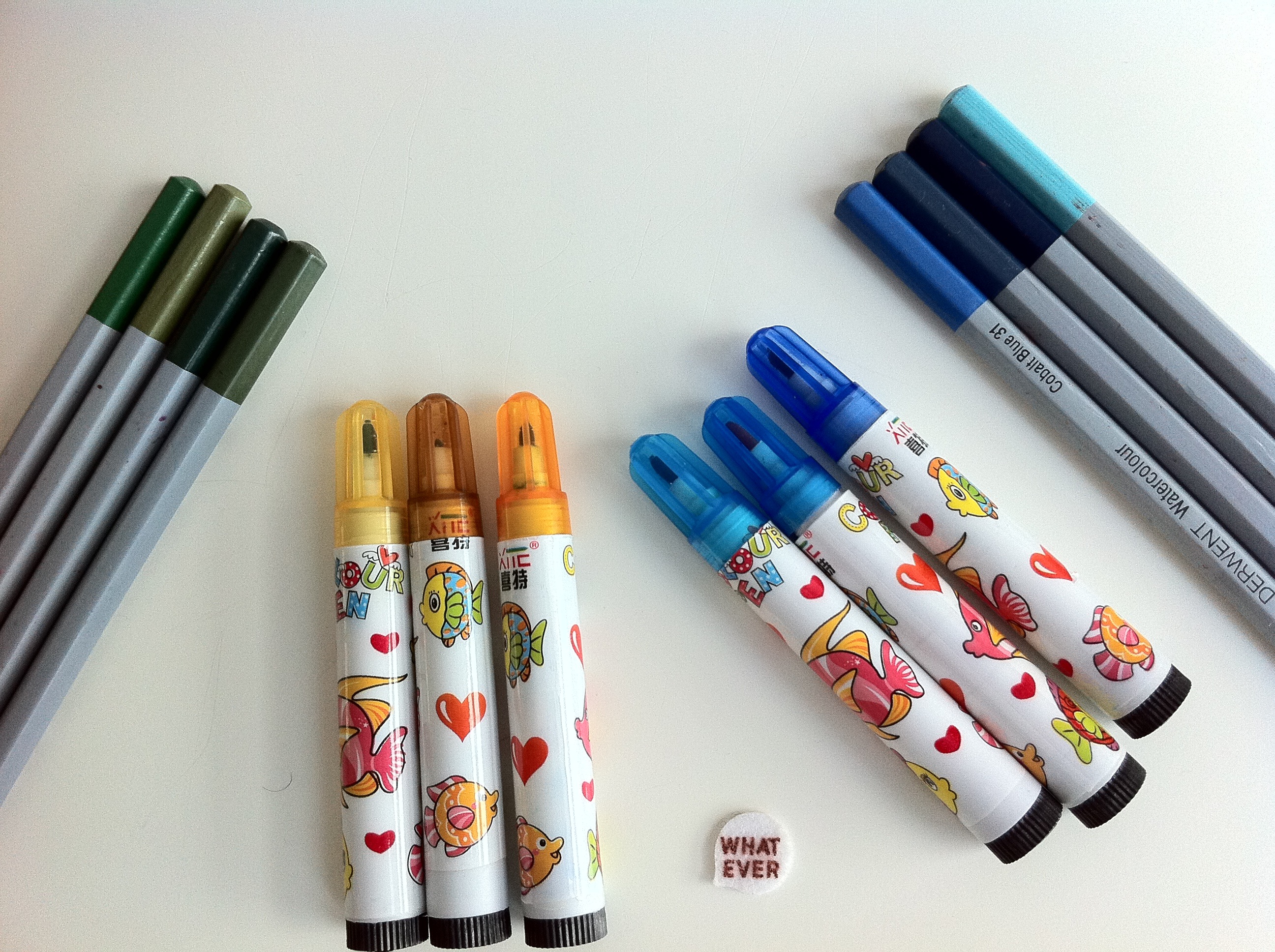
Here is a small selection of Pea’s coloring implements. This photo isn’t too bad as we require a re-stock since the kid goes through these like most of us go through toilet paper or beer or both since they do seem to go hand in hand for us ladies.

There were only a few markers left in her box, the rest having migrated into our own personal black hole where favorite gadgets, trinkets, pens, duckies et al seem to continually disappear. When the seal was still intact, this box had about 6 types of red, blue, green, yellow-browny, mustardy type colors, purples etc.  I saw it in the shop, I thought “oh how lovely, look at all those colors, Pea will love this!”

And then I got home, we got some paper out and this is the exchange we have:

pea: “what’s this?”

me: “violet ma cherie”  (me trying to say purple in French. No sooner have I said it I wonder what violet then is in french if purple is violet and here begins my decent into a hellish color abyss )

Pea, now pointing to another marker “what’s this?”

me, sweat beginning to break out on brow “c’est mauve.” (mauve, is that even a colour in english? and really what’s the difference between mauve and purple or purple and violet, or mauve and violet for that matter)

pea: “What’s this?”

me:  I don’t answer. Is that lavender? Is lavender lighter or darker than violet?

pea: “what’s this?”

me: still silent. Oh great we are in the blues. I think of all the blues I know: teal, navy, turquoise, royal, light, blue-black – Overlooking the fact that this last one is going to be a pain to try to explain,  blue is my favorite color and  I tell myself I know a number of blues. My confidence starts to come back until it hits me:

1. I don’t know all of those in French. Instead I start to think of others in I know in french like bleu ardoise and bleu canard and wonder whether I know these in English. Now my head starts to hurt.

2. Look at the markers in the photograph; there are many blues but most of them are NOT the blues I know. This box is looking less and less like a box of simple colors and more and more like a complex paint selection at home depot.

At least 10 minute have gone by at this point. Pea in the mean time has moved on to reds. What do I know about red?Light? Dark? Wait crimson? Ruby? I am starting to see them all in a police lineup and I can’t identify the perpetrators. Doesn’t matter, she isn’t asking at this point…. thank heavens.

I am ok with the fact that I don’t know the colors because I can get it wrong for me. In my world, I don’t matter. It is my choice.  But what I am suddenly obsessing about is the fact that I am potentially giving my daughter inaccurate information. And here’s the funny thing, I am not sure why it matters but it just does. I don’t want to confuse her. I hate that one day I call something mauve and the next violet. She already has a lot to contend with, 3 languages, a new baby sister, a new country, she doesn’t need her mother flip-flopping Senator Kerry style on colors.

I need a book. A book with all the colors in french, english and spanish. I need a colorist in the true sense of the word.

In the mean time I suggest we  move on to playdoh. She happily  makes the switch. But I know I am only putting off the inevitable.

***

PS Am wondering what her father answers? Does he over analyze the colors? My first thought is he is a man so no. But then I think well he is also an architect working on interior design so maybe. Mental note to self : make colors topic of conversation on next date night. Oh the exciting lives we lead.